29th November: My PhD, My People, My Memories

One year ago, on 29th November 2024, “Dr.” quietly got added to my name. But what stayed with me even more than the title is the day itself. The faces, the feelings, the relief, and that calm you only understand after years of pushing. This post is a small memoir of the journey, from a simple email that opened the door, to leaving home, to building a life in Sweden, and learning that growth often looks like uncertainty, revisions, and showing up again the next day.
More than anything, this is about people. My supervisors, colleagues, friends, and family, the ones who made the hard seasons lighter and the good moments unforgettable. I also share a few lessons I want to carry forward, about feedback, kindness, being seen, and why it matters to ask someone “are you okay?” and then ask again. If any part of this resonates with you, I’d love for you to read the rest.
Today…. 29 November 2025…. marks exactly one year since I graduated with my PhD (29 Nov 2024). And I keep coming back to a simple image: me holding my thesis, a book that looks quiet on the outside, but carries years of loud feelings inside…. hope, fear, stubbornness, joy, doubt, deadlines, and a lot of coffee-room conversations.
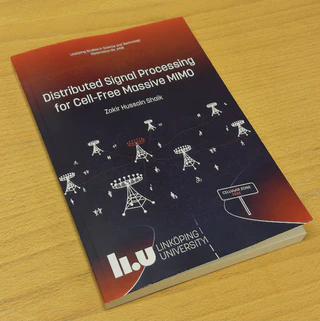
On the day of my graduation dinner, I gave a small speech. It had jokes (because how else do you survive a PhD?), nostalgia, and gratitude…. especially for the people who made the journey feel less lonely. I’m turning that transcript into this blog post today, because anniversaries deserve more than a calendar notification. They deserve a pause.
The beginning…. a door that opened with an email
Like many journeys worth taking, mine didn’t start with certainty. It started with a draft folder on my laptop…. names of professors I planned to email about PhD opportunities. One of those names, Prof. Erik Larsson, was at the top. I sent the message, and the reply came so quickly it almost felt like destiny tapping me on the shoulder and saying, “Let’s go.”
Soon after, I received an invitation to give a talk to the ComSys group…. my first real interaction with the place that would become my academic home. I still remember the mixture of excitement and nervousness: the feeling that this was a chance, and chances don’t come with instructions. I travelled for that visit carrying questions I didn’t know how to answer yet: Am I good enough? Will I fit in? Can I handle this?
And then something quietly reassuring happened. The professors placed their trust in me, the colleagues felt genuinely welcoming, and even the view from the coffee room had this calm beauty that made everything feel a little less intimidating. After the presentation, meeting familiar faces from my Master’s days felt like a warm reminder that I wasn’t starting from zero. In that moment I realized bravery doesn’t always look dramatic. Sometimes it’s very ordinary. It’s simply showing up, taking the first step, and staying there even when you’re scared.
The send-off…. “A ship is safe at shore….”
There is a photo from my airport send-off that still hits me. Family and friends around me, emotions all over the place…. pride, sadness, hope, anxiety, excitement. That day I posted a quote that stayed with me through the entire PhD:
“A ship is always safe at the shore, but that is not what it is built for.”
It sounds motivational (and it is), but it’s also painfully honest. Because leaving the shore means leaving people. Leaving comfort. Leaving familiarity. And as an international student, that distance isn’t just geographic…. it becomes emotional, cultural, and sometimes even physical in a way you can’t explain to someone who hasn’t lived it.
Sweden, firsts, and learning to live alone (properly)
I arrived in August…. Sweden at its best. Autumn colors outside the coffee room felt like the country was welcoming me with a postcard. I was building a new life in a new place, learning new systems, new routines… and very important new skills like cooking (because the local cuisine and my menu had a complicated relationship).
My early kitchen experiments were… an adventure. But slowly I learned how to feed myself in a way that would keep my mother’s worry levels under control. That period gave me a new respect for anyone who cooks daily…. if you do that consistently, you are basically running a life-maintenance startup every day.
And then I saw snow for the first time. I was genuinely happy like a child…. posing, smiling, soaking it in. That kind of joy stays with you because it’s pure and uncomplicated.
The pandemic chapter…. loneliness, small joys, and family on a screen
Then came 2020–2021. Like for everyone, COVID reshaped life…. but as someone who arrived around that period, it sharpened the edges of isolation. There’s a specific kind of loneliness that isn’t “I’m alone and I like my solitude,” but “I’m alone and the world is closed.”
In that time, I learned to cling to small joys without feeling guilty about them. Strawberry picking felt like freedom. A normal day felt like luxury.
And my parents…. through video calls…. became a constant source of energy. When you’re far away, love changes its form. It becomes pixels, voice notes, late-night calls, and the comfort of seeing familiar faces on a rectangle of glass. But it still carries the same weight. It still holds you up.
The real learning curve…. “Well done” → red ink → growth
If I had to describe the PhD experience in one emotional sequence, it might be this:
- You finally get an idea and convince your supervisors.
- You feel like you cracked the universe.
- Then you write the draft…
- And the draft comes back looking like it went through a thunderstorm of red comments.
I still remember how powerful a simple “Well done” felt in an email…. validation that can carry you for days.
And I remember the opposite too: that first heavily-marked draft that made my confidence evaporate in seconds.
But this is the part I’ve grown to appreciate: feedback is not rejection of you…. it’s investment in you. A place that challenges you (without crushing you) is a place where you can become better than your current self.
My supervisors had a balance that I still admire…. never discouraging, never careless, but always honest. The Swedish word for it is “lagom”: not too much, not too little…. just right.
And when I felt low, senior colleagues reminded me: we’ve all been there. That sentence matters more than it seems, because sometimes you don’t need solutions…. you need proof that your struggle isn’t a sign you’re failing. It’s a sign you’re doing something difficult.
The “red book” legacy…. and why my thesis had to be red too
There’s a funny, sentimental detail I love: both my supervisors had their iconic “red book” moments. Watching them hold their books made me think, “When I finish, I want to do that too.” So yes…. I made sure my thesis cover carried its own deep red identity. (Also: dark red is one of my favorite colors, and some people in the room definitely saw that coming.)
But beneath the color is what it represents: perseverance made physical. A PhD thesis is not just research…. it’s a record of how many times you were confused and kept going anyway.
Visibility, kindness, and a lesson from my tiny blog
At some point in the journey, I started this personal blog (zakirtechblog.com). For a long time, my Google Analytics graph looked… calm. Like a desert.
Then I wrote a MATLAB optimization tutorial, shared it on LinkedIn, and went to sleep without expectations. The next morning, I saw a huge spike in visitors. I later realized my supervisor had shared my post with his audience…. selflessly, generously…. making my work visible to people I would never have reached alone.
That act taught me something important:
Support isn’t only about helping you improve. It’s also about helping you be seen.
And it reinforced a belief I’ve carried ever since: knowledge grows when shared. I genuinely enjoy breaking down complex ideas into something digestible…. not because it makes me look smart, but because it makes someone else feel less intimidated by the topic.
Memes, milestones, and the people who made it human
A PhD is often described like a lonely mountain climb. But if I’m honest, the journey became meaningful because of the people around me…. colleagues who turned hard days into lighter ones.
There were colloquium sessions and whiteboard discussions; conferences and presentations; teaching assistant moments that reminded me research is not just output, it’s also impact; small wins like awards; and big wins like nailing ceremonies and defenses.
And of course, the PhD language we all speak fluently: memes. The panic-before-sleep meme. The heartbreak-of-rejection meme. The joy-of-acceptance meme. These aren’t just jokes…. they’re emotional shorthand for experiences we share even when our research topics are different.
Outside work, there were barbecues, board games, fika, lunches, after-work dinners, summer outings, apple picking, badminton rituals, gym motivation, and those conversations that start with research and end with life.
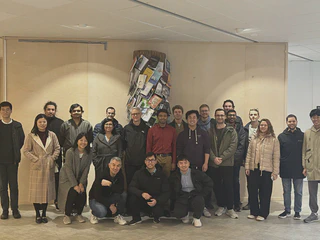
If you take the thesis away, these memories are what remain. And honestly…. they are what I treasure most.
A thesis is never “just mine”
One thing the graduation speech made clear to me: the thesis may have my name on the front, but it carries many fingerprints.
Supervision, feedback, proofreading, Swedish abstract editing, technical discussions, and even the cover design…. all of it shaped the final “book.”
I especially love the symbolism of the cover: a roadmap to cellular networks leading into the cell-free world that became the core focus. It’s nerdy, yes…. but it’s also poetic in the way only research can be…. you start with a map, and you end up building a small road of your own.
The legacy I actually want…. “ask twice”
Near the end of my graduation speech, I shared something that has always felt natural to me, especially in demanding environments where people often carry more than they show. If you notice someone isn’t themselves, ask them if they’re okay, and then ask again. Because the first time, most people will automatically say, “I’m fine.”
It’s not a dramatic philosophy, just a practical habit of care. That second gentle question can be the difference between someone feeling invisible and someone feeling seen. And if I’m remembered for anything, I hope it’s not grand gestures, but small, quiet moments: a coffee shared, a whiteboard full of scribbles, a bit of encouragement, a moment of humor, maybe even my bright-colored shirts. Because that’s a real legacy, being a small warmth in someone’s day, even after you’ve moved on.
One year later
So today, one year after becoming “Dr.”, I’m grateful…. not in a generic way, but in a detailed way.
Grateful for my family, for loving me loudly from far away when I needed it most.
Grateful for supervisors who balanced rigor with kindness, and who shaped not just my research, but my thinking.
Grateful for colleagues and friends who made hard seasons survivable…. and joyful.
And if there’s one thing I’d tell my past self at the airport: you won’t always feel brave, but you’ll keep moving anyway…. and that will be enough.
The PhD journey created ripples in my life…. like that small space-time ripple image I used in my final slide…. and those ripples will always be part of who I am.
To everyone who walked beside me in that chapter: thank you. And to anyone currently in the middle of their own long journey…. keep up the hard work. Success has a strange habit of following people who keep showing up.

Comments